This Week in AI: The Billion-Dollar 'Slow' Week: GPT-5.2, Disney & Death of AI Slop

The holidays were supposed to slow AI down. They didn't.
While you were planning Christmas shopping, OpenAI dropped GPT-5.2, Disney invested $1 billion in generative IP, Runway shipped state-of-the-art video (but forgot the audio), and the entire industry formed a standards body to prevent the AI Wild West from fracturing. Oh, and McDonald's learned the hard way that "AI slop" isn't a business strategy.
This was the "quiet" week. If this is calm, 2026 is going to be absolute chaos.
The Incremental King Still Wears the Crown (For Now)
OpenAI released GPT-5.2 this week with a very specific pitch: "the most capable model for professional knowledge work." Not the smartest. Not the fastest. Not the most creative. The most capable for work.
That's a telling repositioning. While competitors race for AGI headlines, OpenAI is quietly colonizing enterprise workflows. The numbers back it up—on the GDP-Valve benchmark testing real-world tasks across 44 jobs in nine industries, GPT-5.2 now beats expert-level humans more than 50% of the time. GPT-5.1 couldn't do that.
The technical upgrades are solid but incremental. You get a 400,000-token context window with 128,000-token output (roughly 96,000 words out). Near-perfect accuracy on long-context retrieval even at 256K tokens, where GPT-5.1 started hallucinating. Better coding scores on SWE-bench (55.6% vs 50.8% for GPT-5.1), though still trailing Claude Opus 4.5. Improved scientific figure understanding at 88.7% on chart reasoning benchmarks.
Here's what OpenAI isn't saying loudly: this release is about reliability over breakthrough capability. GPT-5.1 had been getting noticeably dumber—making mistakes, hallucinating more frequently, degrading under load. GPT-5.2 feels like OpenAI fixing the plane while flying it.
The pricing? $1.75 per million input tokens, $14 per million output tokens. Standard for this tier. You'll need a paid ChatGPT plan to access it—free users are still locked out.
GPT-5.2 isn't revolutionary. It's professional. And for enterprises building mission-critical workflows on ChatGPT, that distinction matters more than any benchmark.
When Mickey Mouse Meets AGI
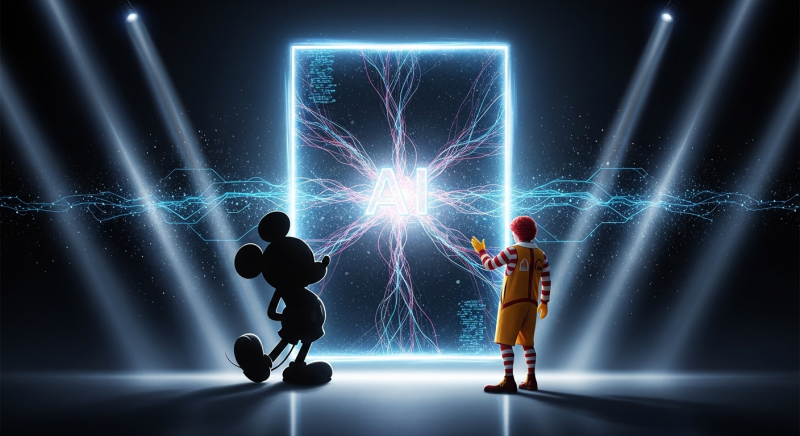
Disney just invested $1 billion into OpenAI. Let that sink in.
This isn't a tech company hedging bets on AI infrastructure. This is Disney—the most protective IP fortress on Earth—handing OpenAI the keys to the Magic Kingdom. The deal gives OpenAI permission to use Disney characters, stories, and worlds inside Sora and future generation tools.
What does Disney get? A seat at the table when AI redefines entertainment. The partnership reportedly includes plans for Disney+ subscribers to generate personalized short videos featuring characters like Moana or Elsa using Sora technology. Imagine: "Create a 2-minute video where Elsa teaches my daughter how to ice skate."
This is generative AI jumping from tech demos to mainstream consumer products. When Disney—historically allergic to risk—bets a billion dollars on AI-generated content, it's a signal that the B2C monetization model for generative AI just went from "maybe someday" to "shipping next year."
The cultural implications are wild. Disney built its empire on scarcity—limited theatrical releases, carefully controlled distribution, premium pricing for access to IP. Generative AI is the opposite: infinite content, personalized on demand, at marginal cost approaching zero.
If Disney is betting this big, the AI content revolution isn't coming. It's here. And every other media company just fell further behind.
The Video Wars: Beautiful...But Where's The Sound?
Runway finally rolled out Gen 4.5 this week, and by the benchmarks, it's impressive. State-of-the-art motion quality. Excellent physical accuracy. Currently ranked #1 on global text-to-video leaderboards. Prompt adherence is exceptional—throw complex multi-object interactions at it, and it nails the details.
But here's the problem: Gen 4.5 doesn't generate audio.
In December 2025, that's a strategic miss. Veo 3.1 has sound. Sora has sound. Kling 1.6 has sound. Hell, even smaller players are shipping with native audio generation because users expect it. Runway releasing a flagship model without audio feels like launching a 2025 smartphone without 5G—technically possible, but why?
The quality is undeniably good. Testing showed Gen 4.5 handles complex prompts with surgical precision—a crystal sphere rolling down marble stairs with water splashing realistically, a barista pouring latte art with accurate steam physics, a futuristic drone chase through neon alleys with sparks flying. It even nails the subtle stuff like handheld camera micro-jitters and proper depth-of-field blur.
Compared to competitors, Gen 4.5 excels at prompt coherence. You can pack a paragraph of specific instructions—lighting angles, camera movements, character emotions, physics interactions—and it delivers. That's valuable for professional workflows where precision matters.
But for most users? They're going to Veo or Kling because those models do 90% of what Gen 4.5 does plus generate sound. Runway is betting that video quality alone justifies the workflow friction of adding audio separately. That's a tough sell when competitors ship complete packages.
Runway built a Ferrari without a stereo. It's fast and beautiful, but in 2025, that's table stakes plus audio. Shipping great video without sound isn't disruption—it's catching up.
The AI Wild West Gets Sheriffs
The Agentic AI Foundation launched this week, and you should care even if the name sounds boring.
OpenAI, Anthropic, Google, Microsoft, Amazon, Block, Bloomberg, and Cloudflare just formed a consortium under the Linux Foundation to create common standards for AI agents. This is huge, and here's why: AI agents are starting to move money, book appointments, manage infrastructure, and make autonomous decisions in production environments. Without shared protocols, every company builds incompatible systems that can't talk to each other.
Think of it like the early internet before TCP/IP standardization. Imagine if every ISP required different protocols, every browser rendered websites differently, and moving between services meant manually translating everything. That's where AI agents are right now.
This foundation exists to prevent that nightmare. The goal is creating interoperability standards so agents from different companies can work together, share context safely, and behave predictably across platforms. It's not about one company controlling the ecosystem—it's about preventing fragmentation that would kill mainstream adoption.
Why now? Because enterprises are actually deploying agents at scale, and they need guarantees. A customer service agent from Anthropic needs to hand off seamlessly to a payment agent from Stripe, which triggers a logistics agent from Amazon, which updates an analytics agent from Bloomberg. If those handoffs are brittle or proprietary, no CFO is signing off on that architecture.
The Linux Foundation stewardship matters too. It's a neutral nonprofit with a track record managing massive open-source projects—Linux itself, Kubernetes, Node.js, PyTorch. This isn't a vendor land-grab. It's infrastructure-building.
Standards are boring until you need them. This week, the AI industry acknowledged that the agent explosion requires plumbing. When the biggest rivals in tech agree to play by shared rules, it means they all believe the market is big enough that interoperability helps everyone. The Wild West era of AI agents just ended.
AI Slop Fatigue Is Real (Ask McDonald's)
McDonald's released an AI-generated Christmas ad this week. The internet hated it.
The ad featured AI-generated people suffering misfortunes—getting thrown out windows, presents falling off cars, getting dragged by trolley doors—all while talking about hating Christmas. It was AI-generated chaos that felt cheap, lazy, and soulless. The backlash was immediate and brutal.
Here's the thing: the ad wasn't technically bad. The AI did what it was prompted to do. The problem is that McDonald's—a multi-billion-dollar corporation with infinite resources—chose to generate slop instead of hiring real talent.
This marks a cultural turning point. We're living through "AI slop fatigue." Social media is flooded with AI-generated content—fake Halloween costumes, synthetic influencers, low-effort memes, clickbait articles. Users have developed radar for AI content, and when they spot it, they resent it.
The McDonald's backlash isn't about AI being bad. It's about companies using AI as a shortcut when they have the budget and obligation to do better. Nobody blames a solo creator using AI to bootstrap a project. But when McDonald's does it? It reads as contempt for the audience.
The lesson for brands: AI tools are incredible for efficiency, iteration, and prototyping. But if your entire execution is AI-generated and it shows, you're not saving money—you're destroying brand equity. Use AI for the 20% that's hard to do otherwise, not the 80% you just don't feel like paying humans to create.
The AI honeymoon is over. Quality matters again. "We made this with AI" isn't impressive anymore—it's a liability unless the output is indistinguishable from or better than human work. McDonald's just paid millions to learn what the internet already knew: nobody wants slop, even if it's generated instantly.
Speed Demons & Democratization
While the headline wars raged, three releases this week quietly redefined what's possible on consumer hardware.
TwinFlow collapsed image generation to a single diffusion step. One step. Traditional models like Stable Diffusion needed 20-30 steps. Zimage still needs 7-10. TwinFlow generates four high-quality images in 5.2 seconds using the same hardware where Qwen Image takes 126 seconds. The team is working on Zimage Turbo integration, which could push generation speeds under one second. When speed increases 20x, the use cases explode—real-time iteration, live generation during client calls, instant prototyping.
Qwen Image I2L lets you train custom LoRAs in 20 seconds with a single reference image. Read that again: 20 seconds. One image. Traditionally, training a LoRA required dozens of images, GPU-intensive compute, and anywhere from 30 minutes to hours. Now you upload one Studio Ghibli frame, wait 20 seconds, and get a LoRA that applies that style to any future prompt. This isn't incremental—it's the difference between "experts only" and "anyone with an idea."
One-to-All Animation shipped a 4.4GB model that animates any character from pose reference video with better consistency than Alibaba's OneAnimate. It handles abnormal proportions—giant heads, tiny bodies, non-human anatomy—and maintains coherence across 20+ second animations. The 1.3 billion parameter version fits comfortably on consumer GPUs. Character animation just became accessible to anyone with a decent gaming PC.
These aren't flagship models grabbing headlines. They're infrastructure releases that lower barriers. When generation speed increases 20x, training time drops from hours to seconds, and animation tools shrink to 4GB, the democratization isn't theoretical—it's operational.
The gap between "pro tools" and "hobbyist tools" is collapsing. Speed, accessibility, and quality converged this week in ways that matter more for most creators than GPT-5.2's incremental benchmark gains.
Signals From The Edge
A few releases this week didn't make headlines but signal where things are heading.
GLM-4-6V from ZhipuAI—the team behind the GLM open-source models—shipped a multimodal vision agent with native tool use. The 9B "flash" version is only 20GB, runs on mid-tier consumer GPUs, and can analyze 150 pages of documents, 200 slides, or an hour-long video. It autonomously searches the web, generates HTML from screenshots, and handles complex coding tasks. It's positioned as an open-source alternative to proprietary vision agents, and for developers building privacy-sensitive or airgapped systems, it's the best option available.
Rivian announced its AI roadmap at their autonomy event, revealing four phases: hands-free driving (shipping now), point-to-point autonomous (2026), eyes-off autonomous (late 2026), and full L4 summon-your-car-from-anywhere autonomy (2027-28). They're also building custom silicon to reduce Nvidia reliance and shipping a "Hey Rivian" voice assistant that controls every vehicle function. When car companies are building agent OS layers and custom AI chips, it's a reminder that AI infrastructure is moving beyond tech companies into every industry.
OpenAI's image model leak: Images allegedly from OpenAI's next-gen image generator (codenamed "Chestnut" and "Hazelnut") appeared on Design Arena and LM Arena. If real, they show world-knowledge integration similar to Ideogram, celebrity selfie generation quality matching Ideogram Pro, and improved text/code rendering in images. No confirmed release date, but the leak suggests OpenAI is preparing to compete in a space where Midjourney and Ideogram currently dominate consumer mindshare.
The edges tell you where the center is moving. Open-source vision agents, automotive AI stacks, and OpenAI's stealth image work all point to the same thing: AI is leaving the chatbot phase and becoming infrastructure.
The Week Ahead
This was supposed to be a slow week. Instead, we got a billion-dollar Disney deal, industry-wide standards formation, and a public backlash marking the end of AI's free pass with audiences.
The pattern is clear: shipping beats teasing, quality beats quantity, and infrastructure beats features. The companies building standards, lowering barriers, and focusing on reliability are positioning for 2026. The ones chasing headlines with incremental upgrades and AI-for-AI's-sake campaigns are already losing the room.
2025 ends not with a bang, but with foundations being poured. The chaos comes next year.
Bangkok8-AI: We'll show you tomorrow's tools...today - so you're never caught out using yesterday's playbook.